
Summer 2026 – halfway between the conclusion of the 2024 World Synod and the 2028 Church Assembly. Where do the local churches stand? What experiences are they having? What are the challenges? Where is the synodal path leading? Mirna Abboud Mzawak, in collaboration with Chantal Ibrahim, focuses her report from the Maronite Church in Lebanon on the local project for a ‘Synod on Women’[*]
„Nothing is more powerful than an idea whose time has come,“ wrote Victor Hugo. This resonates strongly with the Maronite Church’s Synodal Process on the Vocation and Mission of Women in the Church and Society. Effectively, it represents a historic ecclesial reflection embedded with prayer, dialogue, and pastoral action, aiming to enhance a deeper understanding of women’s presence and vocation, strengthen their participation in ecclesial and societal life, and foster greater collaboration between women and men in leadership and decision-making (Foundational Document from the Synod on Women, 2023). Ultimately, the said process seeks to contribute to a more participatory Church and a more inclusive society.
The Lebanese Context: Church, Crisis, and Women
The Maronite Church is Lebanon’s largest Christian community. It is an Eastern Catholic Church in full communion with the Roman Catholic Church (Mahamad, 2009), preserving its own ancient liturgical, theological, and canonical traditions. While the Maronite Church has historically been shaped by such patriarchal structures limiting women’s participation and leadership, women have also played informal roles as educators, caregivers, and spiritual guides within their communities. It is also worth mentioning that it occupies a distinct civic as well as religious place in Lebanon. Since 2019, Lebanon has gone through one of the most severe economic collapses in its modern history, exacerbated by the 2020 Beirut port explosion, ongoing hyperinflation, and, more recently, the renewed regional conflict.
For women, these cumulative crises have added burdens, making them more vulnerable. It is against this backdrop, that the Women’s Pastoral Office’s work since 2012 and the synodal process launched in 2023 have taken on their particular urgency in Lebanon when it comes to women’s vocation and mission within a Church and a country under sustained, ongoing pressure. This is particularly important given women’s agency and indispensable role in terms of crisis mitigation, active actors, refugee support and humanitarian action across all dioceses and parishes in Lebanon.
Implementation of the Synodal Process
The roots of this synodal journey goes back to March 2012, when the Women’s Pastoral Office within the Patriarchal Curia was established. Over the following decade, the Office organized conferences, conducted research, built women’s pastoral committees across the Maronite dioceses of Lebanon, and creacted ongoing channels for dialogue. As these initiatives expanded, a recurring theme effectively emerged. Despite significant contributions made by women in pastoral, educational, social, and ministries, there remained a need for a more comprehensive ecclesial reflection on their vocation, mission, leadership, and participation in decision-making processes. At the same time, valuable developments within the universal Church provided additional momentum into this historical milestone. As Pope Francis stated: “When women are able to fully transmit their gifts to the whole community, the very way society is understood and organized is positively transformed.” (Staff, 2017). Consequently, the Maronite Church found itself pioneering at the intersection of local pastoral needs and broader ecclesial developments, creating fertile ground for the emergence of a dedicated synodal process.
Based on this context, a visionary mission began in 2020 with the establishment of an Ecumenical Strategic Committee entrusted with preparing the synodal process on Women. Its methodology combined brainstorming sessions, focus groups, qualitative questionnaires distributed among ten categories of respondents, and diocesan consultations, all accompanied by continuous dialogue and communal discernment. As a matter of fact, this synodal journey emerged from a growing awareness that contemporary social, cultural, and ecclesial transformations require renewed reflection on women’s participation and leadership. On a last note, what makes this initiative particularly significant is its gradual and methodical development over more than a decade. Effectively, the process has evolved through successive phases of pastoral organization, research, consultation, theological reflection, and practical planning, ultimately becoming one of the most comprehensive ecclesial initiatives dedicated to women in the contemporary history of the Maronite Church (Foundational Document from the Synod on Women, 2023).
The Launch of the Foundational Document
The preparation and implementation phases resulted in the publication of the foundational document entitled Vocation and Mission of Women in the Economy of God, the Life of the Church, and Society, officially launched on 9 September 2023, with a patriarchal blessing and formal endorsement. Its 74 articles, across all three chapters, first map the challenges women face in Church and society, then discuss the biblical, anthropological, and theological foundations, and finally suggest policies and practical orientations on leadership, decision-making, and possible access to church services among others (Foundational Document from the Synod on Women, 2023).
Following this, the pre-synodal assemblies organized played a crucial role in this process by serving as dynamic platforms for open dialogue and reflection. They have effectively provided spaces where diverse voices, including academics, experts, clergy, and lay members, could come together and contribute to the development and continuation of the said synodal process. The purpose of these assemblies was not merely to disseminate information, but to foster sustained engagement and collaboration.
Perspectives and Continuity of the Synodal Process
Since 2023, several intiatives have taken place to implement the foundations discussed in the synodal document such as diocesan-level quantitative surveys identify local needs, informing the training-of-trainers programs, action groups, theatre-based sessions, and related workshops. These initiatives involve women of diverse backgrounds and ages, coordinated by the Women’s Pastoral Office in collaboration with diocesan structures, NGOs, and associations. Furthermore, an important turning point occurred with the Seminar on the Presence and Mission of Women in the Church and Society, held at Bethania-Harissa from 30 May to 1 June 2024. Experts in theology, law, and pastoral ministry reviewed feedback on the foundational document and identified practical projects, generating reports and a set of proposed initiatives including socio-cultural, legal, pastoral, and ecclesial dimensions.
Subsequently, this seminar marked the beginning of a broader implementation phase designed to transform synodal recommendations into concrete actions: specialized committees, diocesan action plans, and a Training Track running from June 2025 to May 2026, established by the Research and Training Sub-Committee to form women leaders in spiritual, theological, and pastoral competencies. Inspired by the model of Christ’s servant leadership, the said training’s aim was to form women capable of contributing actively to collaborative decision-making, pastoral initiatives, and ecclesial governance. Beyond its immediate objectives, the training track represents a strategic investment in long-term institutional transformation by creating a new generation of women leaders prepared to participate more fully in the life and mission of the Church.
Finally, it is important to highlight that several complementary initiatives are being integrated into the post-synodal phase including, but not limited to:
- The Foundational Document regarding the Pastoral Concept and Office
It is integrated as a continuation of the synodal process, providing an operational and structural framework for implementing the foundational orientations.
- The Project entailing the Maronite Identity and its Values
This project focuses on strengthening Maronite identity, particularly among women and youth, through clear objectives centered on: ecclesial identity formation, cultural and spiritual heritage transmission, and community belonging and engagement.
- Christian Leadership Formation Program
This program builds directly on the Training Track and aims to institutionalize leadership formation as a permanent ecclesial structure for women’s empowerment.
Theological and Societal Implications
In regards to this transformative dynamic within the Church and society, it is essential to undertake a critical and reflective analysis of how the biblical, anthropological, and theological foundations presented in the foundational document redefine the place and role of women within the Church. This theological reflection provides an opportunity to understand how such developments may enrich the Church’s overall understanding of faith and mission. It is also crucial to identify potential challenges that may arise during the implementation of these anticipated changes within ecclesial structures. This requires a careful analysis of power dynamics, traditional structures, and possible internal resistance within the Church. Moreover, since the synodal process is not limited to internal ecclesial transformation, it also carries significant societal implications.
On the other hand, this reflection also highlights the unique opportunities offered by this process to strengthen the voice and influence of women, thereby fostering a more equal and inclusive community. In this regard, the continued support of men throughout the synodal process is an essential element for achieving its long-term objectives. Furthermore, it is important to consider the possibility of expanding interreligious dialogue and deepening engagement with broader society. The synod on women in the Maronite Church may thus serve as an inspiring model for similar dialogues in other Christian Churches and even in other religious traditions. This openness to interconfessional and societal dialogue can help build bridges, foster mutual understanding, and promote collaboration in addressing shared challenges faced by women—both within the Church and in society at large.
Conclusion
The Synodal Process on the Vocation and Mission of Women in the Church and Society represents a remarkable journey of ecclesial discernment, participation, and renewal. Beginning with the establishment of the Women’s Pastoral Office in 2012, the process has evolved through successive phases of pastoral engagement, research, consultation, theological reflection, and practical implementation. The publication of the foundational document in 2023, the Seminar in 2024, and the subsequent implementation and leadership formation initiatives demonstrate that the synodal process is not a single initiative but an ongoing journey. Its significance lies not only in its contribution to the life of the Maronite Church but also in its potential to serve as a model for broader ecclesial and societal dialogue on women’s dignity, vocation, leadership, and participation.
Moreover, by reaffirming its commitment to women’s concerns and promoting inclusion, the Maronite Church is opening the way toward a future in which equality and diversity become sources of enrichment. As we acknowledge the significant achievements of this synodal phase, it is essential to recognize that this moment does not mark an end, but rather the beginning of a new era. The transition to the post-synodal phase is of critical importance, offering a unique opportunity to translate the synod’s ideals into concrete realities and to take a meaningful step toward a Church and society in which women are fully recognized and actively engaged in the life of the Maronite Church and the wider community.
On a last note, it is worth mentioning that this process is grounded in a vocational rather than merely a statutory approach to the presence of women in the Church. As previously introduced, it seeks to discern and promote the gifts, charisms, and mission entrusted to women through their baptismal calling, rather than focusing solely on functions, structures, or positions within the Church. In doing so, this synodal process reconnects the question of women’s participation with the fundamental baptismal dignity shared by the People of God, reaffirming that the vocation and mission of every baptized person constitute the primary foundation for co-responsibility, communion, and service within the Church.
—

Mirna Abboud Mzawak is a Full Professor of Social Sciences at the Holy Spirit University of Kaslik (USEK). She holds a PhD in Social Sciences from USEK and currently serves as Coordinator of the IDEES Multidisciplinary Research Group and Director of the Higher Center for Research (HCR).
Her research and community engagement focus on active citizenship, local community development, women’s empowerment, social cohesion, family and community dynamics, and cultural pluralism. She currently leads SAWA for Active Citizenship, a project supported by the Lebanese Ministry of Social Affairs.
In addition to her academic and research leadership, she serves as Coordinator of the Office for the Pastoral Care of Women within the Maronite Church and leads the Maronite Church’s Synod for Women.
References:
Mahamad, S. (2009). A comparative study of Bible of Barnabas and four traditional gospels. https://core.ac.uk/download/144523640.pdf
Maronite Patriarchate. (2023). The vocation and mission of women in the economy of God, the life of the Church, and society: A foundational document for the synodal journey in the Antiochene Syriac Maronite Church. Bkerke.
Staff, Z. (2017, June 9). Pope’s Address to Plenary Assembly of the Pontifical Council for Interreligious Dialogue. ZENIT – English. https://zenit.org/2017/06/09/popes-address-to-plenary-assembly-of-the-pontifical-council-for-interreligious-dialogue/
[*]Part 5 of the series „From the 2024 Synod to the 2028 Ecclesial Assembly – Interim Reflections from Around the World“ with contributions from Africa (July 20), Latin America (July 22), North America (July 24), Europe (July 27), the Middle East (July 28), and Asia (July 29).
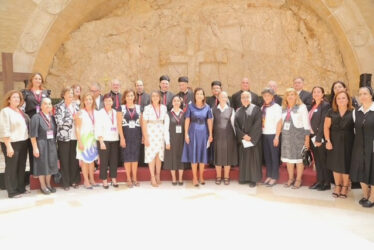
Header image: Launching of the foundational text of the synodal process on women.
This article is also published in German.