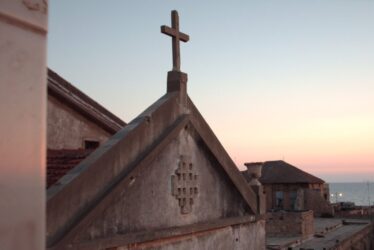

Once again, Christians in Lebanon are awaiting Easter under a barrage of bombs. Rima Nasrallah from Beirut on despair and the hope that comes from remembrance.
Behind a thick plume of black smoke rising from the site of the last bomb, the red edges of the church’s roof come faintly into view. Gradually, the silhouette of the stone cross at its peak emerges. The bombing of Beirut has been going on for weeks. Throughout this time the congregation of the National Evangelical Church of Beirut, along with all Christians in Lebanon, has been journeying towards Easter. This is not the first time in the history of this community when violence, bombs, and fear accompany the Easter season. In the past fifty years, multiple wars and crises have shaken it and even completely destroyed this particular building. The pain however, is still the same. “How long, O Lord? have you forgotten us?”, the community of faithful cries out!
At moments like these the community laments and remembers. Current wars remind of the war of 1975, of the invasion of 1982, of the devastation of 2006 and stories are rehearsed and shared among friends and family. Remembering and Lamenting are ancient forms of prayer. Though this might not match with the expected Easter cheer, I believe this connects with a deep truth revealed on the cross and confirmed in the experience of the empty tomb.
Remembering and Lamenting are ancient forms of prayer.
The lament rising from a devastated city merges with lament everywhere and echoes a scriptural literary genre; one where sufferers address themselves to God through a cry of distress. This distress originates from a tension or discrepancy between God’s prior promises and the lamenter’s current situation; a discrepancy between how things ought to be and how things are in reality[1]. The Psalms are our ultimate example of lament literature. In them we read the call of distress describing one’s own suffering and experience of injustice and longing for justice and salvation; for things to be different.
This same pattern is found in the gospel narratives, particularly the synoptic gospels. Jesus’ ministry is marked throughout with shouts and cries of distress from the poor and the hungry, the ill and the excluded: “Jesus, son of David, have mercy on me” (Luke 18:38).
However, Jesus is not only receiving the lament of the sufferers. He also shares in this lament. His journey to Jerusalem is paved with sighs and tears. He is heard lamenting the state of his city. He is witnessed lamenting the bad leadership of the community. He is seen lamenting the death of a dear friend. And ultimately, he laments the betrayal, abandonment and pain on the cross. Just like the inhabitants of countries like Lebanon, who feel abandoned and in distress, who witness injustice and abuse, Jesus cries, gets angry and pleads with the father “why have you forsaken me?”, embodying our human lament and frustration.
Betrayal, abandonment and pain on the cross
In the passion narrative, one particular encounter brings Jesus’ double engagement with remembering and lament to the fore clearly. Hanging on the cross, flanked by two thieves on each side, Jesus becomes simultaneously the one expressing and the one receiving lament. He voices his distress and fear to the Father and at the same time responds to the one who pleads with him: “Jesus, remember me” (Luke 23:42). The chasm between the one who laments and the one to whom lament is addressed collapses; human suffering and divine response merge into one body.
It is interesting that the request here is for Jesus to remember. The act of “remembering” is key in scripture. When God saw the suffering of the people in Egypt, he answered their lament by remembering (Exodus 2:24). When Jeremiah heard of the calamities that will befall his people, he pleaded “Lord, remember me” (Jeremiah 15:15). Numerous Psalms ask the Lord to remember and to act in mercy. How wonderful it is that God’s response to lament is remembering.
Memory becomes constitutive to identity
By remembering, God affirms that those who are suffering protracted wars and prolonged injustices are not forgotten and will not disappear into nothingness. God affirms that their experiences, pains and losses are scooped up into God’s memory. And that God carries them into his person. Memory studies connect remembering with identity. By remembering people and events, the memory becomes constitutive to identity[2]. God’s response to lament is to remember. On the cross Jesus responds to the lament of the one suffering beside him, by assuring him that he is remembered; that surely he will be with him. He carries his pain into his own scarred and broken body.
Jesus himself is God’s act of remembering
In fact, Jesus himself is God’s act of remembering us as humanity. In the face of our distress, as an answer to our cries and laments, he remembered us with and in Jesus. Even more, through the cross and resurrection, Jesus gave us the ministry of remembrance. At the tomb, the women who were lamenting are told by men in dazzling clothes to “remember”, to remember the promise and the response to the promise; and then they “remembered”, says the gospel of Luke (Luke 24: 4-5). Our Eucharistic sharing is ultimately an act of remembering, through which we remember God’s response to our lament. “Do this in remembrance of me”, says Jesus.
What does celebrating Easter mean to a community whose memory is heavy with war and suffering? What does Easter bring to a community in lament? It brings the certainty that in Jesus we are remembered and in turn it entrusts us with a ministry of remembering God’s answer to suffering. As the smoke subsides in the city of Beirut, the cross appears more clearly against a blue sky stating: “Truly I tell you, you are remembered”.
____
[1] See Walter Bruggemann, ‘The Costly Loss of Lament’, in Journal for the Study of the Old Testament 36 (1986), 57-71. And Channing Crisler, The Synoptic Christology of Lament: The Lord who answered and the Lord who cried, Lexington Books, 2023.
[2] See Erll, Astrid, and Ansgar Nünning, eds. Cultural Memory Studies: An International and Interdisciplinary Handbook. In collaboration with Sara B. Young. Berlin and New York: Walter de Gruyter, 2008.
Foto credits title: Jerusalem Cross in Sidon/Libanon (c) Michael Koller, CC BY-SA 3.0, https://de.wikipedia.org/w/index.php?curid=2875090

Rima Nasrallah, professor of Practical Theology and Academic Dean at the Near East School of Theology. Ordained minister at the National Evangelical Church of Beirut. Her field of expertise is liturgical-ritual studies and Eastern Churches.