
Summer 2026 – halfway between the conclusion of the 2024 World Synod and the 2028 Church Assembly. Where do the local churches stand? What experiences are they having? What are the challenges? Where is the synodal journey leading? Estela Padilla reports on developments in the Philippines[*].
How does an idea transform into a national movement? From 2021, the local churches/dioceses in the Philippines have engaged positively with Pope Francis’ call of Synodality, forming Diocesan Synod Teams, who in turn formed Parish Synod Teams. The dioceses also decided to assemble as a metropolitan structure for more affective and effective ‘walking together’. A National Synod Team (which I led until 2024) now called Commission for Synodal Transformation coordinated and continues to facilitate the whole synodal renewal process.
The call to synodality was a welcome change for the Philippine Church, not just a breath of fresh air, but could also be a generative idea that would inspire new dreams and integrate a lot of pastoral pathways happening in the local churches in the country.
Habitus-forming Questions
I noticed that there are three questions that keep inserting themselves among us Synod Teams that show how synodality is becoming a habit and a lifestyle.
- One is about listening. When we have meetings or designing programs, we find ourselves taking a pause and asking: “Who is not here? Whose voices are we not hearing? What could be the opinion of those made poor and those at the margins?”. Listening has been the banner of Synodality from the very start and in the Philippines, during the consultation sessions from 2021, a lot of dioceses made it a point to reach out to different social sectors – e.g. farmers, fisherfolks, vendors, Persons Deprived of Liberty, Persons with Disabilities, LGBTQ+, out-of-school youth, etc.). This has also been a personal conversion for me – a deeper awareness to engage and journey with those made poor and the marginalized as subjects – giving them space and voice for they too have gifts to exchange and are co-responsible for the Church’s mission.
- The other question is about methods: “How could we do this more synodally?” When we as a Synod Team is working on a program or facing challenging situations, we pause to ask ourselves “How can we do this in a synodal way?” Perhaps we will think of collaborating with others, or enter into discernment for our next steps. Another example: Our bishops – as a conference – usually make a stand on socio-political issues in the country. They would articulate this through a pastoral statement that will be read in all the parishes. Usually 2-3 bishops will draft the statement, then it will be presented to the body for comments and revisions. But last year, when the Bishops were about to make a pastoral statement, one bishop asked “How can we do this more synodally?”. And they used the Conversation in the Spirit, entering into a communal discernment process on our biggest political issues and took a stand as a pastoral guide to the Catholic faithful.
- The third question is: “What conversions need to happen?” Conversion is the energy that moves the whole Synodal renewal process. We want to follow God more faithfully. When we have Synod sessions, this is usually the first question in the sharing groups: “What (personal and pastoral) conversions have you experienced recently?” Moreover, when we do synodal pastoral planning, we no longer go from Goals to Action Steps. After goals have been articulated, before we plan action steps, we ask the question: “What (personal and pastoral) conversions need to happen so that we can reach our goals?” The Synod is not just a program or a project but our continuing discipleship story.
From Emergent Change Model to Transformative Praxis
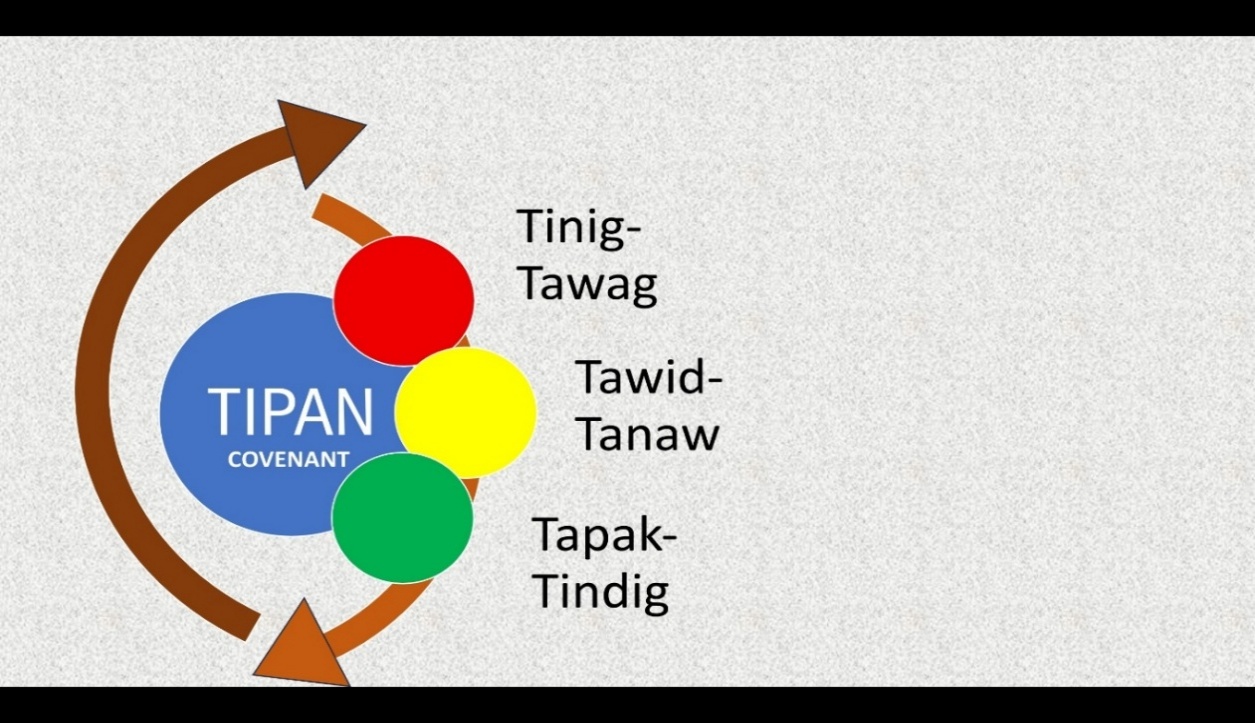
Last year 2025, the implementation process has begun. In the Philippines, in July, we held the National Synodal Implementation Planning to design a synodal implementation process in the country. All dioceses in the country were represented by their bishops and a member of the Diocesan Synod Team, resulting in 100% participation. This Assembly designed the National Synodal Implementation Framework called Sulong-Padayon, using the 4Ts Culture-based Grounded Change Management Model designed by the Commission for Synodal Transformation (CST). This model was followed in this Assembly and we were able to create a National Synodal Implementation Framework. Following were the process and product of this model followed in the 3-day National Assembly. The 4Ts stand for:
- TINIG-TAWAG (Voice – Call);
- TAWID-TANAW (Conversion, Crossing – Dream, Vision)
- TAPAK-TINDIG (Footprint – Commitment)
- TUNGO SA TIPAN (Covenant)[1]
Tinig-Tawag: Listening to All and Clarifying the Call
Listening to the Tinig (voice) is the first step in any synodal process: listening to the voice of experience, of the signs of the times, of all stakeholders, and also the poor and the marginalized.
In crafting the national framework, we listened to the Tinig (voices) gathered from below. In April and May 2025, the Commission for Synodal Transformation asked the Diocesan Synod Teams to answer the following questions:
1) share new programs/structures/processes since the Synodal Journey started in 2021;
2) share challenges they have experienced in implementing a Synodal Church; and
3) discern where is the Spirit of God leading us towards becoming more synodal (through Conversation in the Spirit).
Then, the Diocesan Teams gathered at the Metropolitan level so they can share their experiences and responses to these 3 questions; after which the Commission for Synodal Transformation facilitated several regional gatherings. All the responses to these questions were gathered and from the responses emerged the Five Characteristics of a Synodal Church in the Philippines, the discerned Tawag (call) from God.
Emerging from the data of all the regional assemblies, the Five Characteristics of a Philippine Synodal Church emerged:
1) Listening, Discernment and Accompaniment;
2) Inclusive Participation: Basic Ecclesial Communities, Grassroots, Marginalized Sectors;
3) Formation for Conversion and Mission;
4) Accountable and Collaborative Leadership Governance Structure;
5) Partnership and Outreach.
Tawid-Tanaw: Being Converted and Setting our Goals
When we clearly hear God’s call, we are called to enter into a conversion process so that we can respond to and embody God’s call. We need to cross (Tawid) from one state, attitude, behavior and action to another way of living as a response to God’s call.
In the National Assembly, the small groups reflected on what crossings and conversions need to happen so that we can live out God’s call in the specific characteristic of a Synodal Church on which the group is reflecting on. The Conversation in the Spirit was used to discern the call to conversion.
As we go through the process of conversion, we can see (Tanaw) more clearly where God wants to lead us (Tanaw na!), the goals of our synodal journey. Through another Conversation in the Spirit, the small groups discerned on God’s dream or goal (Pananaw) in the specific characteristic of a Synodal Church they are assigned to.
The following are the TANAW-Dream Statements of the 5 Characteristics of a Synodal Church:
1) Listening, Discernment and Accompaniment: We dream of a Church that listens not just with the ears but with the heart – a church that knows how to stay and be silent, and how to walk with the wounded (FD[2] 28-29, 45,78)
2) Formation for Conversion and Mission: We dream of a Church where formation is lifelong, rooted in Christ, and alive with mission – a church that teaches not only doctrines but teaches how to love (FD 32, 43-44, 51-52, 81, 143)
3) Accountable and Collaborative Leadership Governance Structure: We dream of a church led by servant leaders – where authority is not a privilege, but a responsibility shared in trust (FD 36, 75-77, 89-104)
4) Inclusive Participation: Basic Ecclesial Communities, Grassroots, Marginalized Sectors: We dream of a church where everyone belongs and no one is invisible (FD 50, 56, 117,123)
5) Partnership and Outreach: We dream of a church that steps into the world with open hands – ready to serve, to dialogue, and to witness to Christ in every space (FD 41,47,120)
We dream of a Church …
…that listens not just with the ears but with the heart – a church that knows how to stay and be silent, and how to walk with the wounded.
…where formation is lifelong, rooted in Christ, and alive with mission – a church that teaches not only doctrines but teaches how to love.
…led by servant leaders – where authority is not a privilege, but a responsibility shared in trust.
…where everyone belongs and no one is invisible.
…that steps into the world with open hands – ready to serve, to dialogue, and to witness to Christ in every space.
Tapak-Tindig: Creating an Impact and Renewing our Commitment
The goals/dreams/vision become the beacon that will light the path towards becoming a Synodal Church.
The small groups were asked to reflect on Pathways to Change, steps that will make a mark and create an impact (Tapak). Participants were asked to contribute their new and radical ideas by visiting different tables that contain the following synodal pathways:
1) Formative Encounters;
2) Structures and Mechanisms;
3) Inclusion and Diversity;
4) Cultures and Practices;
5) Collaboration and Networking.
Authentic transformation is facilitated by agents of change who embody their convictions (Paninindigan, Tindig) in both their daily life and ministry. The bishops, clergy, lay and religious met among themselves and were led to reflect on their individual roles in leading the Synodal Journey. On pairs of slippers gifted to all, they wrote their roles and God’s expectations of them, as well as the wishes of their fellow bishop/clergy/religious/lay, and prayed for one another.
Tipan: Returning to the Covenant with God
In abiding love (covenant), God always calls us to renewal (ecclesia semper reformanda) and entrusts Jesus’ mission to us. Becoming a Synodal Church is a way for us to renew our covenant (Tipan) with God. The whole assembly, was guided by prayer, Bible sharing, conversation in the Spirit and Eucharistic Celebration.
The Tanaw-Tawid-Tapak (Goal-Conversion-Pathways to Change) becomes the National Synodal Implementation Framework to be inculturated in different local churches as they become more responsive to the ecclesial and social challenges to their specific contexts and cultures. This is the covenant (Tipan) of the local church in becoming a missionary Synodal Church in the Philippines.
The whole document is downloadable (Sulong-Padayon National Synodal Implementation Framework SNSIF) but let me just give here one example to see the flow of all the steps:
# 4 Inclusive Participation: Basic Ecclesial Communities, Grassroots and Marginalized Sectors.
TANAW (Vision): We dream of a Church where everyone belongs, and where no one is invisible. A Synodal Church reaches out to everyone: families, women, the poor, indigenous peoples, LGBTQIA+, Persons with Disabilities, the elderly and the youth. It honors their voices and invites their gifts. Inclusion is not an initiative but our identity. Basic Ecclesial Communities become seeds of synodality at the grassroots.
TAWID (Conversion): From spectator to actor; from result-oriented to process-oriented; from functional to pastoral approach
TAPAK (Pathways):
1. Restructuring Church Governance for Grassroots Empowerment
- Adopt a “down-to-top planning” structure by “restructuring pastoral and finance council into an inverted pyramid”— beginning with the Basic Ecclesial Community → Sitio → Chapel → Archdiocese.
- Ensure “subsidiarity and solidarity” in decision-making with “consultation and dialogue” as guiding principles.
2. Cross-Sector and Interfaith Collaboration
- Strengthen “intergroup collaboration with NGOs, GOs, and religious organizations”
- Promote “clustered BEC gatherings for cross-learning” and “inter-ministerial teamwork and intragroup collaboration.”
- Organize “regular interfaith and ecumenical dialogue” and support inclusive and diverse dialogue of life.
Concluding Thoughts
Synodality as a way of life (modus vivendi et operandi, SLMC[3] #6), can only happen if we are guided by the Spirit of God. Being converted to God, to God’s reign, in the midst of our wounded yet hopeful world, is the aim of the Synod. It is both spiritual and structural renewal (FD 18) so that the light of Christ illumines our path and we can walk together with all of humanity in search of the common good. The late Pope Francis has expressed: “Synodality is what God expects of the Church in the third millennium” (SLMC #1). Indeed be “a prophetic force for today’s world” (FD 5)! Through habit-forming questions and facilitating a change model that leads to transformative practice at the local and grassroots levels, the Synodal Church in the Philippines is joyfully and courageously moving forward!
—

Estela P. Padilla is a lay theologian working for Bukal ng Tipan, Inc., a lay mission team which journeys with different dioceses in the Philippines and abroad towards the vision of a participatory and synodal church. As a member of the 16th General Assembly of the Synod of Bishops, she is deeply involved with the Commission on Synodal Transformation for the Philippines and Asia. She has also worked with the Commission on the Laity and the Office for Theological Concerns for the Asian Bishops‘ Conferences for two decades and with Basic Ecclesial Communities in the Philippines all her life. She has two doctorate degrees in Applied Theology and Organization Development.
- Literal translation: Tinig (voice), Tawag (call), Tawid (to cross the road), Tanaw (to look at), Tapak (to step on the ground), Tindig (to stand for), Tipan (covenant). The need for brevity hinders the exploration of deep cultural nuances of these words for the Filipinos in a journey. ↑
- FD = Francis/XVI Ordinary General Assembly of the Synod of Bishops, For a Synodal Church: Communion, Participation, Mission. Final Document (October 2024). ↑
- SLMC = International Theological Commission, Synodality in the Life and Mission of the Church (March 2018). ↑
[*]Last part of the series „From the 2024 Synod to the 2028 Ecclesial Assembly – Interim Reflections from Around the World“ with contributions from Africa (July 20), Latin America (July 22), North America (July 24), Europe (July 27), the Middle East (July 28), and Asia (July 29).
This article is also published in German.
Translated from English with the help of AI, edited by Daniel Kosch
Header image: Synod Logo, adapted for the Philippines.