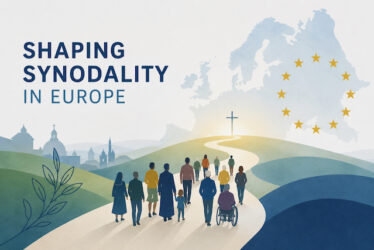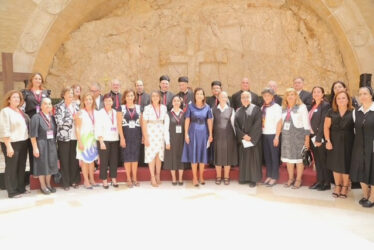

In a series of six contributions from all parts of the world[*], feinschwarz has, over the past ten days, offered insight into the state of the synodal process – halfway between the World Synod 2024 and the Ecclesial Assembly 2028. Daniel Kosch prepared the articles for publication. He explains the context and records a few observations.
From the Council, through the Synod of Bishops, to the World Synod
Shortly before the end of the Second Vatican Council (1962–1965), Pope Paul VI introduced the “Synod of Bishops” at the level of the universal Church. In doing so, he gave concrete form to the strengthening of episcopal collegiality decided by the Council and to the Church’s necessary aggiornamento. Fifty years later, Pope Francis strengthened and energized this institution in keeping with the vision he set out in Evangelii Gaudium of a Church that overcomes clericalism and actively involves all the baptized in its mission. Even before the Synod on the family, he had already ensured that not only bishops from around the world, but the entire people of God in the dioceses, were involved in the preparation. In 2015, on the 50th anniversary of the Synod of Bishops, he gave a programmatic address whose core message was that synodality is a “constitutive dimension” of the Church.
The Synodal Process of the Universal Church
With the decision to hold a Synod of Bishops on the theme of “synodality” in 2023, Pope Francis gave it additional weight. In the course of the synodal process, which began in 2021 and ended with the second session of the Synod in 2024, this significance was reinforced in three ways:
- First, through the inclusion of non-bishops, especially women, as voting members – combined with the renaming of the “Synod of Bishops” simply as “Synod.”
- Second, through the extension from one session to two, with an interim phase in which local churches and the people of God were again involved.
- Third, through the decision to forgo a “post-synodal exhortation” by the Pope. In a note accompanying the Final Document, he stated that the 2024 Synod session was not the “end” of the process, since the synodal transformation was to continue – particularly through implementation in the local churches.
At the same time, an “Ecclesial Assembly” was announced for 2028; its preparation and substantive shaping are again to involve the local churches, the national bishops’ conferences, and the continental ecclesial assemblies. Pope Leo XIV has since adopted and given concrete form to a roadmap already envisaged by Pope Francis for this purpose.
This development thus moves
- from the Synod of Bishops to a synodal process of the entire people of God, involving all the baptized;
- from the Synod as a single event to a permanently established synodality as a form of being Church and of ecclesial decision-making;
- from a rather static, hierarchical understanding of Church to a dynamic, participatory one.
The Final Document of the 2024 Synod as a Roadmap
At the beginning of the process, “spiritual” and “structural” reforms were often played off against each other, and the debates revolved around individual reform topics. By now there is consensus that all of it is needed: a synodal culture and spirituality, synodal structures and procedures, as well as concrete synodal events and decisions that anchor synodality more firmly in the law and teaching of the Church. The roadmap for this is the Final Document of the 2024 Synod, which Pope Francis stated forms part of the ordinary papal magisterium. It is binding not only for the universal Church but also for the local churches and bishops’ conferences, and, in accordance with the Pope’s will, is to be implemented from now on.
The Synodal Process Facing a Risky Transition
Nevertheless, the fear is voiced here and there that synodality “remains an ecclesiological notion introduced with great effort but ultimately short-lived” (Michael Seewald) – should the open theological and canonical questions not be resolved. In the German-speaking world, trust in the synodal process is, in the view of many reform-minded Catholics, additionally burdened by the fact that “Rome” is putting obstacles in the way of implementing the resolutions of the Synodal Path (e.g., blessings for same-sex couples, lay preaching), and that the Roman recognitio (approval) of the statutes for a permanent synodal body (the “Synodal Conference”) is being delayed. These concerns must be taken seriously, as must the ongoing resistance from bishops and parts of the Curia to a profound synodal transformation that would lead to binding arrangements for shared responsibility, accountability, transparency, and evaluation of ecclesial governance. Some fear that things will stop at a merely declared, half-hearted “culture change” and at “conversations in the Spirit” as the lowest common denominator. Not only in the Church are boldly announced reforms watered down and postponed once it becomes clear that they come at a price – such as loss of power and influence, great effort, or “leaving the comfort zone.”
It is all the more important, in this delicate transitional phase – between the World Synod and its reception, at the halfway point between the 2024 Synod and the 2028 Ecclesial Assembly – not to look only “toward Rome.” If synodality concerns everyone, its implementation also depends on everyone. It can also fail locally: in the diocese, at the bishops’ conference, or at the continental church level. Klara Csiszar emphasizes that synodality finds itself “in a liminal phase”: “There is broad agreement at the level of principle […], but in many places the inculturation into a lived practice is missing. The gap between resolution and habitus is the real problem of this halfway point.”
Six Contributions from Around the World
For this reason, feinschwarz.net gathered six voices from all parts of the world for a small series of contributions. They were meant to inform about, and reflect on, the state of the synodal process in their own context. The request was deliberately worded openly, including on the question of which level(s) of church life should be addressed. Accordingly, depending on the report, the focus is primarily on local, diocesan, or continental church developments – or on several levels at once. Moreover, these are not meant to be the most comprehensive possible analyses, but rather insights into the authors’ own experiences and perspectives. That they are exclusively women was not intentional. But it shows how important their contribution is – and that a lasting strengthening of synodality will only succeed once a Church that struggles with the “question of women” becomes a Church of which a far higher proportion of women than today can say, with conviction, that it is a “Church with the women.”
Because several contributions were written in English – and in the hope that the series would find interest beyond the German-speaking world as well – all of them appeared in German and in an English working translation produced with the help of AI. The contribution from Africa also appeared in its original language, French. This is also meant as a small contribution from the Church in the German-speaking world – often criticized as too self-referential – toward exchange, dialogue, and networking within the universal Church.
Specifically, the series comprises the following contributions:
- Sr. Anne Béatrice Faye «I Believe in the Synodal Church: An African Testimony»
- Sr. Birgit Weiler «The path is made by walking – The Synodal Process in Latin America»
- Linda Staudt «Living Synodality – A Look at Canada» (for North America)
- Klara Antonia Csiszar «Staying together in the tensions, instead of being split by them» (for Europe)
- Mirna Abboud Mzawak «The Synodal Process on the Vocation and Mission of Women in the Maronite Church» (fort he Near and Middle east)
- Estela Padilla «Sulong-Padayon – the Philippine Synodal Church Moving Forward» (for South East Asia)
Commonalities and Differences
The contributions are so diverse that any attempt at a “synthesis” would be doomed to fail. Such an undertaking would also be anti-synodal: the path toward greater synodality also involves increased inculturation into each particular context, and the resulting diversity is intended. That is why perceiving what is distinctive, and the differences between the reports, is just as important as the commonalities. Nevertheless, as a result of reading and preparing these texts, I would like to record a few subjective, somewhat random observations.
Synodality – Necessity Born of Hardship, and Opportunity at Once
It is often expressed that strengthening the synodal principle is necessary in the sense that it addresses hardships, weaknesses, difficulties, and challenges. At the same time, the impulses given by Pope Francis are experienced as rich in opportunity and inspiring. The process set in motion at the level of the universal Church is, on the whole, viewed positively.
“Conversation in the Spirit” – But Not Only That
In many contributions, “conversation in the Spirit” appears as a kind of “hallmark” of the synodal Church – at every level, from the local parish council to the bishops’ conference. At the same time, efforts are visible to embed it within a more comprehensive approach, reflected upon methodologically and in terms of organizational development – for instance through social-science surveys, consultative procedures, and more complex process architectures.
Synodality Has a Societal Dimension
The strengthening of synodality is perceived as relevant not only within the Church but also for society as a whole, and thus politically. This applies to the tension-laden state of the world, in which dialogue and mutual understanding struggle to prevail. It applies equally to social contexts in which patriarchal patterns, discrimination and marginalization of certain groups, or tensions between religious communities burden coexistence. Accordingly, several reports also address the need to involve non-members, people on the margins of society, and members of other religions.
Synodal Formation and Synodal Learning Are Indispensable
The majority of the reports address the need not merely to initiate educational and learning processes, but to establish them on a lasting basis. The range of addressees extends from pastoral workers in training, through committed lay people, to bishops. The spectrum of offerings ranges from the “School of Synodality” to open, free, multilingual online courses (MOOCs).
Synodality Needs Women, But Also Men
Many reports emphasize the strengthening of the role of women and the indispensability of their contributions. At the same time, it is highlighted that – albeit in a different way – men, too, are caught up in the synodal transformation: they must learn and help carry the new way of being together. The focus here is by no means only on male officeholders, on whom far too much still depends, but also on the change in male role patterns within the societal context.
The Synodal Process Is Nothing New or Additional
Several reports show that the synodal process builds on developments that already existed beforehand. These are reinforced and given legitimacy at the level of the universal Church, but remain rooted in each local reality. This holds true for synodal structures as much as for the focus on particular themes or groups of people (for example, in the form of a specialized office for women’s pastoral ministry). Moreover, the synodal processes do not run “alongside” what needs to be done anyway. Rather, the Church’s existing, concrete tasks are approached synodally – from the drafting of “pastoral guidelines” by the bishops’ conference, through the formation of pastoral workers, to the restructuring of cooperation within parish clusters and the merging of parishes. This favors good solutions that are broadly supported.
Outlook
Anyone who has read the six insights from the halfway point of the implementation phase between the 2024 Synod and the 2028 Ecclesial Assembly needs no prophetic gifts to predict that this will be a further step on a lasting path of learning, not a conclusion. At the level of the universal Church, this path requires taking into account not only the experiences of the local churches, but also translating the numerous demands of the 2024 Final Document into binding norms and procedures. However unavoidable the appeal to patience and to the necessary “long haul” may be, it would be just as risky if 2028 left behind nothing more than the impression of synodality as a “never-ending story.”
In the “Pathways for the Implementation Phase,” the General Secretariat of the Synod therefore calls for “investing in the concreteness of practices” (section 3.2). In doing so, it recalls the statement of the Final Document: “Without concrete changes in the near future, the vision of a synodal Church will not be credible” (no. 94). The reports from six regions of the universal Church show that this message has been received there. Klara Csiszar puts it this way in her contribution: “I believe it is growing together. Slowly. Often painfully. But it is growing.” In keeping with the circular structure of the synodal process, it will be an important task for the bodies of the universal Church, with a view to the 2028 Ecclesial Assembly, to likewise improve, for their part, the conditions needed so that things do not remain mere well-intentioned reform rhetoric, and so that the synodal principle can increasingly shape the Church’s concrete decision-making processes and its actions as a whole.
At the same time, it must be borne in mind that, given the current state of the world, it would be more than questionable if the pursuit of sustainably strengthening synodality were to turn the gaze too strongly inward. Very much in keeping with the voices gathered from around the world, the Secretary General of the Synod, Cardinal Mario Grech, emphasized in his assessment during the Extraordinary Consistory of 26–27 June 2026:
“Synodality is not an end in itself. It exists so that the Church may proclaim the Gospel more effectively and serve the men and women of our time more faithfully. We live in a world marked by profound transformations. Wars and violence continue to wound entire peoples. Social inequalities are increasing. Migration is reshaping the face of our societies. New technologies are changing the way we communicate, learn, and even understand ourselves. Many people are searching for meaning, hope, and authentic relationships. Many look to the Church for a credible witness to the Gospel.
Faced with these challenges, synodality appears ever more clearly as a missionary resource. It helps the Church to listen more attentively to the questions of humanity, to recognize the signs of the times, to value the gifts of all, and to discern together the steps to be taken. […] At a global moment marked by the tragedy of a geopolitics that has become accustomed – almost resigned – to war and economic domination, Ecclesia in Synodo perficiendo can become, for the history of the human family, a sign of the times: a witness to a style of governance and participation shaped by the evangelical virtue of meekness. The beatitude of meekness is the spiritual soul of the synodal journey”.
—
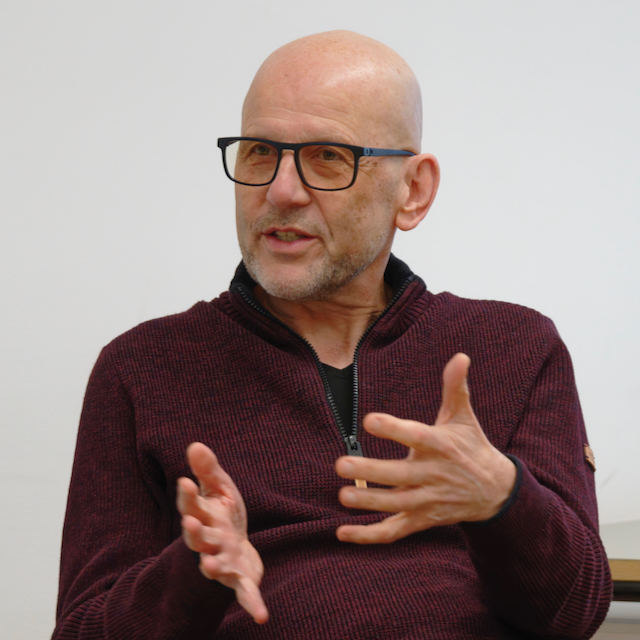
Daniel Kosch, Dr. theol., war von 2001-2022 Generalsekretär der Römisch-Katholischen Zentralkonferenz der Schweiz (RKZ) .
Jüngste Publikation: «Synodal und demokratisch. Katholische Kirchenreform in schweizerischen Kirchenstrukturen» (Edition Exodus, Luzern 2023).
Foto: Christoph Knoch
[*]Links to the Individual Contributions
- Sr. Anne Béatrice Faye «I Believe in the Synodal Church: An African Testimony»: https://www.feinschwarz.net/i-believe-in-the-synodal-church/
- Sr. Birgit Weiler «The path is made by walking – The Synodal Process in Latin America»: https://www.feinschwarz.net/the-path-is-made-by-walking-latin-america/
- Linda Staudt «Living Synodality – A Look at Canada»: https://www.feinschwarz.net/living-synodality-canada/
- Klara Antonia Csiszar «Staying together in the tensions, instead of being split by them»: https://www.feinschwarz.net/staying-together/
- Mirna Abboud Mzawak «The Synodal Process on the Vocation and Mission of Women in the Maronite Church»: https://www.feinschwarz.net/the-synodal-process-on-the-vocation-and-mission-of-women-in-the-maronite-church/
- Estela Padilla «Sulong-Padayon – the Philippine Synodal Church Moving Forward»: https://www.feinschwarz.net/sulong-padayon-the-philippine-synodal-church-moving-forward/
This contribution is also published in German (original version). The English translation was produced with the help of AI.
Header Image: synod.va (detail)